
Designed objects · Discovery
Thonet No. 14 Chair
You are reading the English original. Read in English
A bentwood chair where a few repeated curves carry an entire social history.
Summary
A bentwood chair where a few repeated curves carry an entire social history.
Reading status
A design reference and visual reading, not an authentication or structural safety check.
At a glance
A light café chair made from curved timber, a circular seat, and a small number of repeatable parts.
Why it matters
Start with the visible
The No. 14 is a lesson in economy. The chair's identity is not a single ornament but the way bending, joining, and repetition make a familiar place to sit.
Look closer
Three details to carry with you
- 01
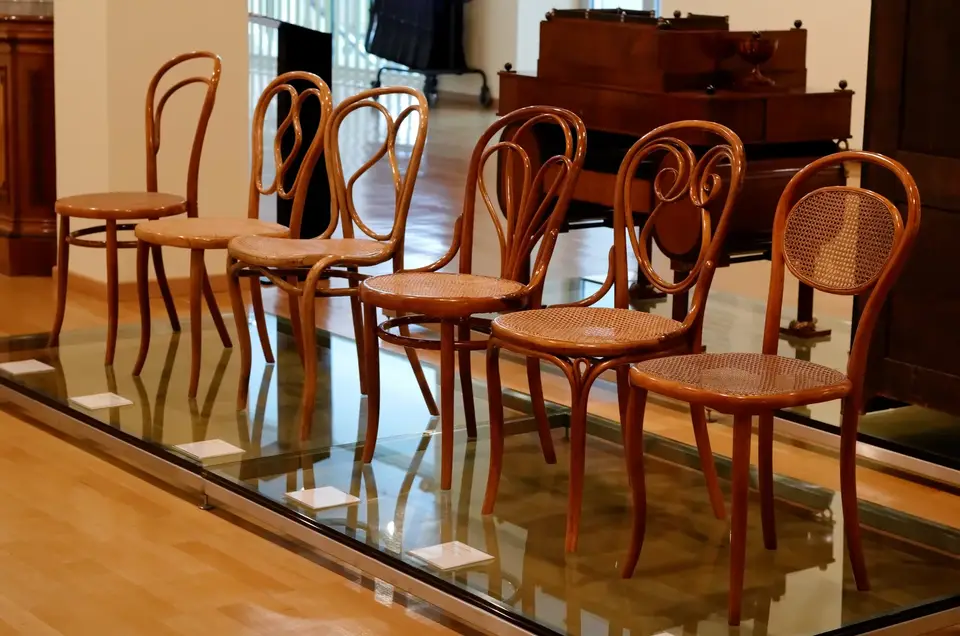
Follow the bentwood loops around the back and legs.
- 02
Compare the open space beneath the seat with the density of the joints.
- 03
Notice how the repeated chair would change a room more than one chair does.
Material and method
Steam-bent wood · Cane seat · Standardised screws and joints
Story and context
Thonet's nineteenth-century production methods helped make bentwood seating repeatable and transportable, changing how cafés and public interiors could be furnished.
Culture and context
The chair is often presented as a design classic. Its wider story is about manufacturing, distribution, and the visual rhythm of a room filled with copies.
Keep certainty visible
- The image shows a group of Thonet chairs and does not prove a specific No. 14 chair or date.
- A photo cannot assess joinery, authenticity, or structural safety.
Interpretation
One way to read it
The chair feels light because its construction is a sequence of curves rather than a block of material.
Another reading
The repeated curve can also feel institutional. What reads as elegance in one chair may read as discipline when multiplied.
Take another look