
Art and sculpture · Flagship
The Great Wave off Kanagawa
You are reading the English original. Read in English
A wave becomes an arch, a claw, and a frame for a small mountain.
Summary
A wave becomes an arch, a claw, and a frame for a small mountain.
Reading status
A documented print example. The exact impression, paper, and condition would need to be checked against a collection record.
At a glance
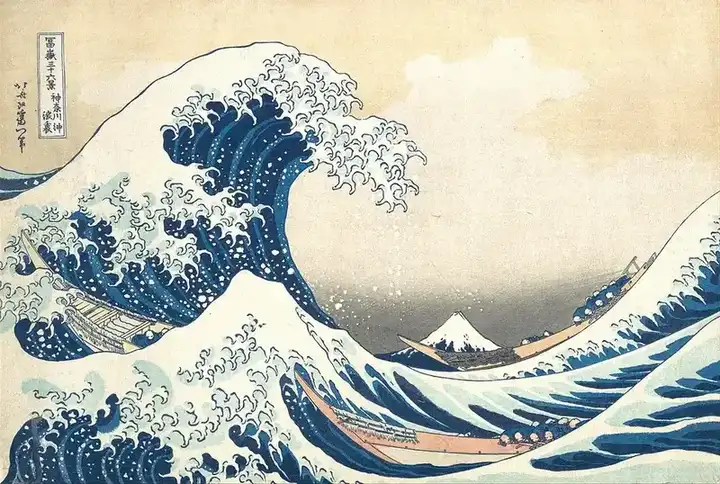
A towering wave curls over boats while Mount Fuji holds a small, quiet triangle in the distance.
Why it matters
Start with the visible
The famous wave is not only about scale. Hokusai sets up a visual contest between curling water, the boats, and the quiet triangle of Mount Fuji.
Look closer
Three details to carry with you
- 01
The foam at the wave's edge echoes fingers or talons. Follow that line down to the boats.
- 02
Compare the small human figures with the mountain. The picture makes distance feel like pressure rather than emptiness.
- 03
Notice how the blue, white, and beige areas lock together like a designed pattern.
Material and method
Carved woodblock lines · Flat areas of colour · Repeated print structure
Story and context
The print belongs to Hokusai's Thirty-six Views of Mount Fuji series and was made for circulation as an affordable image rather than a singular painting.
Culture and context
Its familiar silhouette can hide the visual intelligence of the print. The mountain is not merely scenery; it is the quiet counterweight that makes the wave legible.
Keep certainty visible
- The page discusses a known print design, not the condition or edition state of any particular impression.
- A reproduction can flatten paper, ink, and scale, so the web image is a starting point for looking.
Interpretation
One way to read it
The wave feels frightening and ornamental at once. Its danger is made memorable by the same rhythm that makes it beautiful.
Another reading
Another reading is that the boats are not victims of the wave but the line that lets us measure its force.
Take another look